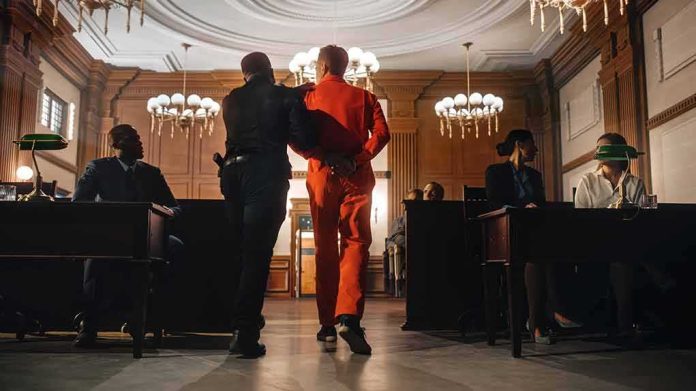
Plea bargaining, not jury verdicts, decides the fate of most high-profile violent felonies; Antonio Brown’s Miami case is a textbook example of how evidentiary risk, witness cooperation, and sentencing exposure converge to produce a deal that trades trial uncertainty for guaranteed accountability without prison.
At a Glance
- Prosecutors charged Brown with attempted second-degree murder; he is set to resolve the case through a negotiated plea that avoids prison.
- Brown’s lawyer says prosecutors offered the deal and that the reduced count will carry probation, not decades of incarceration.
- The defense has consistently framed the incident as lawful self-defense under Florida’s Stand Your Ground regime.
- Witness cooperation shifted: reporting indicates the sole alleged victim stopped participating, a common inflection point in serious-felony negotiations.
What the plea signals — and what it does not
The public headline is straightforward: after months of litigating an attempted second-degree murder charge tied to a post–celebrity boxing event altercation, Antonio Brown is taking a plea deal that spares him prison time. The defense says prosecutors extended an offer “he couldn’t refuse” — a reduced charge with probation rather than a decades-long sentence if convicted at trial. That tells you two things prosecutors and defense lawyers both understand. First, sentencing leverage in Florida for serious felonies involving firearms is immense; the possibility of a mandatory-minimum term drastically reshapes risk analysis for any defendant. Second, when a case’s single complaining witness announces he will not participate, the trial posture changes overnight, and so do the incentives to resolve the file short of verdict. A plea is not an adjudication of the original narrative; it is a negotiated end to litigation risk.
Brown’s posture alongside that deal remains consistent with his prior filings. He pleaded not guilty, asserted self-defense, and, according to his attorney, pursued Stand Your Ground relief — a statutory, pretrial mechanism that can result in dismissal if a judge finds lawful defensive force. Accepting a prosecutor-offered reduction with probation resolves exposure; it does not retroactively litigate those self-defense claims. In other words, the plea outcome speaks to risk management more than it does to a definitive factual finding.
How Florida’s machinery makes deals likely in hard cases
To understand why this outcome was predictable, you need the structural context. Florida’s criminal courts run on negotiated pleas, including in violent and firearm cases. The doctrine is settled: trial courts can accept bargained resolutions; negotiated pleas are routine vehicles to balance the state’s need for certainty against a defendant’s need to cap exposure. Case law across decades reflects this equilibrium — from nolo contendere pleas in attempted murder with a firearm to decisions underscoring counsel’s constitutional duty to advise clients competently about plea offers because the plea stage is often “the critical phase” in modern criminal adjudication. The state secures a conviction and avoids the real possibility of jury nullification, witness collapse, or evidentiary exclusion; the defendant avoids extraordinary sentencing risk that a single adverse ruling or witness answer can lock in at trial. That is the plea-bargaining exchange, in practice and in precedent.
Layer on two practical pressures typical in a high-visibility case. First, witness reliability. If the prosecution’s primary witness signals non-cooperation, the state must weigh subpoena power, material-witness holds, and the optics and logistics of compelling testimony. Second, resource allocation. Homicide-adjacent trials are expensive in investigator time, expert preparation, and court bandwidth. A sure result on a lesser count can be rational governance. These are not exotic features of this file; they are the daily physics of a large urban prosecutor’s office.
The competing narratives: charge severity versus self-defense
From charging through negotiation, two stories ran in parallel. The state’s version, embedded in an attempted second-degree murder count, alleged criminally culpable violence serious enough to justify the threat of decades of incarceration. The defense’s version holds that Brown used defensive force under Florida’s Stand Your Ground framework — a law that, beyond trial self-defense instructions, offers a pretrial immunity hearing where the judge can dismiss if the use of force was justified. Defense counsel said Brown fired warning shots to deter aggression and safely reach a vehicle; they also filed to test that theory against the statute’s immunity standard. Reporting that the sole alleged victim chose not to participate further narrowed the terrain for adjudicating those claims at trial, increasing the gravitational pull toward a plea.
Which account “wins” in the historical record? Neither, in the sense a jury never resolves them. The legal system often ends contested narratives through contract — the plea — when both sides price the uncertainty of proof. That does not make the original charge baseless or the defense invincible; it means both sides found a number they could live with under Florida law and institutional constraints.
What probation in a violent-felony context practically means
Probation is not a handshake; it is a court order with teeth. In Florida, conditions typically include reporting, restrictions on weapons, possible curfews or geographic limits, treatment requirements if applicable, costs and surcharges, and, for firearm-related conduct, often community service and victim-related conditions where legally permissible. Violating terms can snap the case back to court and expose the probationer to incarceration on the underlying offense. For a public figure, the reputational and logistical demands are non-trivial: travel must be cleared, missteps are news, and any new police contact can trigger a violation hearing. So while “no prison” captures the top line, the day-to-day reality is structured and supervised.
From a prosecutor’s vantage, probation paired with a conviction — even to a reduced count — is accountable closure. It records criminal responsibility in the system, keeps leverage over future conduct, and broadcasts a message about consequences without risking a trial reversal or mistrial. From a defense vantage, avoiding mandatory minimum exposure is the whole game; once that is off the board, rehabilitation and life reconstruction can proceed under supervision rather than custody.
Why witness cooperation changes everything
Serious violent cases often hinge on a small number of percipient witnesses. When the sole alleged victim of a shooting informs the state he will not cooperate, the evidentiary puzzle loses its center. Yes, prosecutors can proceed with other evidence; yes, hearsay exceptions and physical proof sometimes suffice. But juries evaluate stories told by people. A reluctant or absent victim forces the state to contemplate alternative theories of proof, impeachment landmines, and the fairness optics of pressing ahead without the person supposedly harmed — all while the defense is prepared to pound reasonable doubt. The ESPN report that the accuser stood down arrived just before the deal posture firmed up, a timing alignment seasoned trial lawyers will recognize instantly.
The larger lesson: outcomes are policy in action
This case is not an aberration; it is a mirror. Florida’s statutes supercharge trial risk in firearm cases; its appellate decisions entrench plea negotiations as a lawful and pervasive resolution mechanism; its Stand Your Ground framework offers defendants a robust pretrial dismissal pathway that can reshape bargaining dynamics. When a key witness disengages, the probability distribution shifts, and a prison-free plea becomes not a “sweetheart” deal but a rational settlement within the system’s own design. You do not have to like that design to acknowledge its logic. But understanding those mechanics — leverage, proof, statutes, precedent — is the only honest way to read a headline that says a once life-altering charge ended in probation.
🚨🚨Former #Steelers Antonio Brown will accept a plea deal in his attempted m*rder case, resulting in probation and AVOIDING the possibility of a 30-year prison sentence.
The sole alleged victim announced that he would no longer participate. pic.twitter.com/s9B0BLcE9W
— NFL Rumors (@nflrums) September 23, 2026
Bottom line
Antonio Brown’s case underscores how modern American criminal justice actually works. Prosecutors protect a conviction; the defense neutralizes catastrophic risk; the court conserves trial time; and the public gets closure without the catharsis of a verdict. The legal truth that matters here is structural: in a system built to reward certainty and penalize risk, a prison-free plea in a serious case can be the most predictable outcome of all — especially when the witness at the center walks away from the stand.
Sources:
facebook.com, wfmd.com, miamiherald.com, marca.com, nypost.com, nbcmiami.com, espn.ph, dailymail.com, cbsnews.com