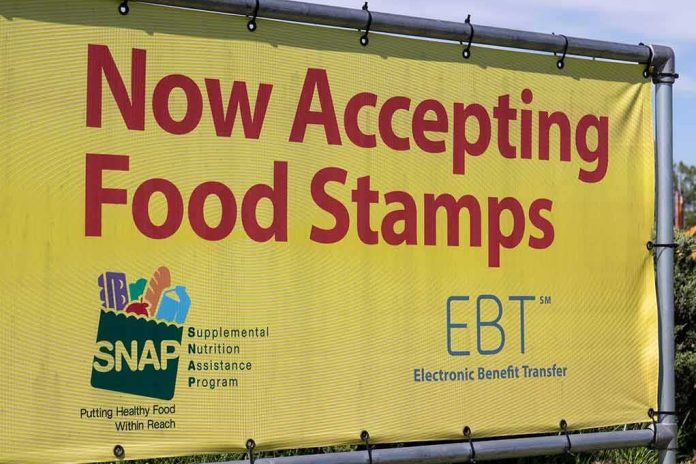
Shutdown politics don’t just freeze a budget line; they test whether the nation’s nutrition safety net can function when Washington stops. The controversy around Sen. Chris Murphy’s anecdote about “Jason and Keri” underscores the core reality: when the Supplemental Nutrition Assistance Program (SNAP) hits a funding wall, families face immediate risk and officials pivot to an argument about law, discretion, and contingency money that was supposedly built to prevent that risk.
At a Glance
- Murphy tied a concrete hardship story—“Jason and Keri” losing food stamps—to a shutdown-era halt in SNAP disbursements and to decisions by the administration about contingency funds.
- During shutdowns, SNAP’s mandatory-benefit promise collides with operational limits: states administer the program, monthly issuances require cash flow, and contingency reserves become a legal and political battleground.
- The executive branch has at times refused to use SNAP’s contingency fund for regular monthly benefits, prompting lawsuits and, in 2025, court orders compelling its use to keep payments flowing.
- This is not a new pattern; prior lapses triggered workarounds, watchdog scrutiny, and ongoing debate over how much authority USDA has to bridge appropriations gaps.
What Murphy said, and why it struck a nerve
Sen. Chris Murphy has long made shutdown resilience a political and policy theme. On his annual walk across Connecticut, he cited “Jason and Keri,” whom he said lost SNAP benefits “because of Trump’s cuts,” describing a six-hour round trip for a soup-kitchen meal. The point landed because it personalized a system-level failure: monthly SNAP issuance stops mean empty EBT cards, not abstractions. Murphy’s own office resource page reinforces the mechanics behind the anxiety—while SNAP is a mandatory program, the ability to send out benefits can be affected by a shutdown, with only about 30 days of issuance assured absent further action.
That framing links two separate but related levers. First, disbursements halt during appropriations lapses unless there is authority and funding to continue. Second, the administration’s choice to deploy (or withhold) the SNAP contingency fund becomes the fulcrum for both political blame and legal remedy when the 30-day runway ends.
How SNAP actually moves money during a shutdown
SNAP is federally funded but state-run. Benefits are “mandatory”—eligibility-driven, not capped by annual discretionary appropriations—but the monthly issuance still relies on a mix of appropriated funds, timing workarounds authorized by law, and a statutory contingency reserve. USDA schedules states’ monthly loads to EBT processors; when appropriations lapse, the department can sometimes advance payments within a narrow window relying on provisions that permit certain obligations within 30 days of a shutdown’s onset. That’s a bridge, not a solution. If a shutdown persists into the next issuance cycle, the system needs either new appropriations or a legally available pot such as the SNAP contingency fund to keep cards loading on time.
The contingency fund exists for precisely this kind of strain. Yet agencies have argued that it can supplement shortfalls only when benefits have already been appropriated, not when there is no appropriation at all—an interpretation USDA articulated again in 2025. That reading shifts the program from “entitlement with a backstop” to “entitlement that still depends on Congress every month, with the reserve off-limits absent an appropriation signal.” The technical fight is narrow; the human implications are not.
The 2025 shutdown fight made the legal stakes explicit
In October 2025, as the shutdown dragged on, USDA advised that November’s SNAP benefits would not be disbursed and said it would not use contingency funds to cover them. That stance triggered a wave of political pressure, including from Senate Democrats who said the reserve was created to prevent precisely this gap. Republican senators also introduced legislation to keep benefits flowing, an acknowledgment that the stoppage was imminent without either executive action or new statutory direction.
Courts quickly became the venue of last resort. Cities, organizations, and state attorneys general sued, and federal judges ordered the administration to use the contingency fund to continue SNAP payments during the shutdown; one ruling went further, directing USDA to tap other funding if the reserve proved insufficient. Those orders cut through the interpretive impasse: regardless of the executive’s view of the fund’s legal availability, the judiciary required continuity of benefits while Congress remained at loggerheads.
Why stories like “Jason and Keri” surface every time Washington stalls
SNAP is politically salient because it is immediate. A third of recipients are children; many households shop weekly. The program’s $8 billion monthly scale means that even a short lapse cannot be “crowdfunded” by charities at any meaningful fraction of need. In earlier shutdowns, USDA used early-payment authorities to get ahead of a pending lapse and later drew watchdog scrutiny for how it structured those moves. In 2025, with those options exhausted and the reserve contested, the monthly cliff became visible to households—and to the politicians who represent them.
This is the cycle: advocates frame disruption as preventable cruelty; administrations argue that anti-deficiency law and appropriation doctrine constrain them; Congress splits between insisting on executive latitude and insisting on legislative fixes. Meanwhile, states and food banks brace. New Jersey and others accelerated grants to food banks as the 30-day window closed, a tacit concession that retail benefits might not arrive on time without intervention.
Parsing causation: cuts, contingency, and responsibility
Murphy’s shorthand—linking “lost food stamps” to presidential decisions—folds distinct mechanisms into a single narrative. On one hand, a shutdown is, by definition, a failure of appropriations; on the other, the administration’s refusal to use the contingency fund for regular benefits moved the program from “tight” to “stopped,” and courts said as much by compelling its use. The legal debate over the fund’s availability is real; USDA’s memo argued the reserve could not lawfully replace regular appropriations for November issuance. But the judicial rulings—binding in the moment—held that continuity was required using that very reserve, with the prospect of tapping further funding streams if needed.
For affected households, the distinction is academic. The question that matters is whether the EBT load appears on schedule. In 2025, absent court intervention, USDA’s stance would have left November benefits unfunded. That is the context in which a senator meeting a couple on a bus to a soup kitchen reads not as theater but as a field report from the last mile of an administrative fight.
Design lessons for a sturdier safety net
Three reforms emerge from this recurring drama. First, clarify in statute that SNAP’s contingency fund is explicitly available to sustain monthly issuances during lapses in appropriations up to its balance, with automatic triggers and reporting—eliminating interpretive whiplash and the need for emergency litigation. Second, build a longer glide path by allowing states to schedule and pre-obligate multiple months of benefits under narrow safeguards when a shutdown is reasonably foreseeable, grounded in the 30-day authority precedent but codified rather than improvised. Third, require a uniform, public issuance calendar and contingency dashboard so households, retailers, and state agencies receive the same, timely signal when federal levers are pulled or stuck.
Sources:
twitchy.com, washingtontimes.com, abc7.com, washingtonexaminer.com, assemblydems.com, murphy.senate.gov, hagstromreport.com, townhall.com, redstate.com, hotair.com, congress.gov, kff.org