

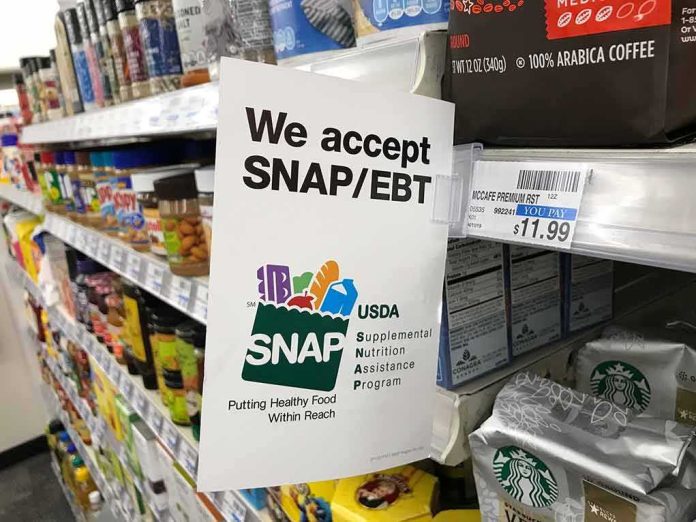
SNAP’s fiercest fights are not about fraud; they are about where to draw the line between uniform federal eligibility and state flexibility. The Trump administration’s move to curtail “broad-based categorical eligibility” (BBCE) squarely targets that boundary, trading administrative simplicity and broader access for tighter adherence to federal income and asset tests.
At a Glance
- USDA has proposed a formal rule narrowing SNAP categorical eligibility to households receiving TANF assistance as defined in federal regulation, effectively ending state use of non-cash TANF-linked BBCE to widen access.
- The department estimates the change would reduce federal SNAP outlays by about $44.6 billion over five years and remove 3.2 million households (6.3 million people) in the first full year of implementation.
- BBCE’s core function has been to let states simplify enrollment, ease asset tests, and use higher gross-income cutoffs while still requiring low net income; its rollback revives stricter uniform limits.
- Supporters frame the change as restoring statutory safeguards; critics warn of heightened food insecurity, more red tape, and shifted costs to states.
What the rule does and why it matters
The proposal is not a press release; it is a notice-and-comment rulemaking in the Federal Register that would confine SNAP’s categorical eligibility to households actually receiving Temporary Assistance for Needy Families (TANF) assistance as defined at 45 CFR 260.31. In practical terms, that shuts down states’ use of non-cash, TANF-funded or maintenance-of-effort services—like informational referrals or pamphlets—to confer SNAP eligibility wholesale. USDA argues those BBCE pathways have enabled a significant de facto expansion of SNAP by allowing higher gross-income thresholds—often up to 200 percent of the federal poverty guidelines—and by eliminating or loosening resource (asset) limits, even though net income rules still apply. The department’s regulatory impact analysis projects a federal SNAP benefit reduction of roughly $44.649 billion from FY 2027 through FY 2031 and estimates that, by FY 2029, 16.9 percent of current SNAP households—about 3.2 million households and 6.3 million individuals—would no longer receive benefits under the tighter criteria.
Understanding the mechanism is essential. SNAP traditionally screens households on gross income (generally 130 percent of poverty), net income (100 percent after allowable deductions), and assets. BBCE—widely adopted after the late-1990s welfare overhaul—lets states bypass the federal asset test and set higher gross-income cutoffs, conditional on a TANF-related trigger, while retaining the federal net-income test. The Congressional Research Service (CRS) has long documented that structure: BBCE broadens the front door and reduces paperwork, but does not override the net-income requirement for a positive benefit. The proposed rule removes that state option; it does not allege that benefits were improperly paid under BBCE where states lawfully elected it.
How we got here: the long tug-of-war over BBCE
BBCE grew out of the 1996 welfare reform’s emphasis on state discretion and was formalized by USDA around 2000. Over two decades, states used it to streamline enrollment, align SNAP with other low-income supports, and soften or eliminate asset tests—especially as participation spiked during and after the Great Recession. As budgets and caseloads swelled, critics came to view the same flexibility as a backdoor expansion. This expansion–retrenchment cycle is familiar: administrative simplification expands access during downturns; later, concerns about targeting, costs, and program integrity prompt a swing back toward uniform federal rules. The Trump administration advanced a similar BBCE retrenchment in 2019; this rule reprises that philosophy with a formal, quantified proposal and clear legal contours.
Two clarifications separate signal from noise. First, USDA’s analysis quantifies households that would fail federal gross-income or resource tests once BBCE is removed; that is not synonymous with fraud. The agency’s docket, as publicly summarized, does not present case files of high-asset or “millionaire” recipients who were improperly approved; rather, it asserts that state-designed non-cash TANF triggers have extended eligibility beyond statutory intent. Second, the savings estimate is a model—useful for policy judgment, but contingent on participation, state responses, and economic conditions. It is neither an audit nor a guarantee.
The strongest case for the rule: restoring statutory guardrails
Supporters have a coherent statutory and administrative case. Congress set baseline SNAP income and resource standards; categorical eligibility was meant to avoid duplicative screening where another stringent means test already applied. When states link SNAP to nominal TANF-funded services—without a cash or robust means-tested benefit—categorical eligibility can become a vehicle to lift gross-income thresholds and bypass assets statewide. USDA’s Federal Register text describes this as a “significant increase” in effective thresholds, not an incidental alignment. Tightening the categorical trigger to TANF assistance as defined in regulation reasserts the original logic: if another substantial, federally recognized means-tested program has already vetted a household, shortcut the paperwork; otherwise, apply statutory SNAP screens directly.
That logic resonates with a common-sense concern: eligibility pathways should reflect comparable rigor. CRS’s primer confirms that BBCE can push gross-income caps to 200 percent of poverty and, in most states, remove the asset test entirely, even as the net-income test still binds. For critics of BBCE, this architecture risks muting SNAP’s targeting function and complicates cross-state equity—similar families can face different rules depending on a state’s TANF-linked design.
The best counterarguments: access, administrative load, and food security
Opponents, including anti-hunger advocates and more than 200 House Democrats, argue the cure is worse than the disease. They accept USDA’s own participation estimate as proof of the stakes: removing BBCE would cut off approximately 6.3 million people in the first full year, with older adults, people with disabilities, and families with children disproportionately represented; some households could lose nearly $200 per month in assistance on average, they say. They predict the rollback will increase paperwork and processing delays, raise administrative costs for states, heighten the risk of erroneous denials, and push more demand onto already-stressed food banks—all while weakening work incentives for near-threshold workers who would lose eligibility under restored asset tests or lower gross-income caps.
These are serious concerns because they speak to mechanism, not just sentiment. Asset verification is administratively intensive, and states have historically used BBCE to remove friction for both agencies and applicants. If states must reintroduce asset tests and lower gross-income caps, churn—the cycle of exiting and reapplying—can rise, exacerbating underpayments and delays. Critics also warn of collateral effects, such as breaking automatic links to free school meals for children in SNAP households. While the public record here is rooted in advocacy and press statements rather than formal cost studies, the direction of the administrative burden is plausible given how BBCE functions.
Where the genuine uncertainty lies
Two unresolved questions should discipline how we read the projections. First, how much of the modeled benefit reduction reflects households with substantial liquid assets or higher gross incomes but low net incomes—versus households who remain economically vulnerable by any common-sense measure yet fall just outside restored thresholds? USDA’s topline numbers do not provide a decomposition of affected households by reason for loss, assets, and income mix in publicly accessible summaries. Second, could targeted tools—asset data matching, focused verifications, or post-certification audits—achieve comparable integrity gains with less disenrollment? The rule’s impact analysis centers on eligibility and fiscal effects; it does not present head-to-head alternatives with administrative costings in the excerpts cited.
These gaps do not discredit the rule; they define the next round of scrutiny. If the goal is to align SNAP with statutory letters while minimizing avoidable hardship and bureaucratic load, an evidence-based comparison of categorical rollback versus targeted integrity tools would be probative. Likewise, independent replication of the $44.6 billion savings model under different participation and labor-market scenarios would strengthen confidence in the fiscal case.
What to watch as the rule advances
Expect the public narrative to focus on headline losses—6.3 million is a large number—while USDA emphasizes statutory fidelity and taxpayer savings. That is a predictable asymmetry: the costs of tightened screens are immediate and visible; the benefits of cleaner targeting are abstract. For readers trying to cut through the noise, three indicators will matter. First, the final rule’s treatment of transitional issues—recertification schedules, documentation standards, and any state flexibilities that survive—will determine the scale of administrative strain. Second, any credible, disaggregated analysis of who loses benefits and why will clarify whether the policy principally trims marginally better-off households or pushes deeply needy families off the rolls. Third, external validation—by GAO, CRS syntheses, or inspector general reviews—of both payment accuracy and net fiscal effects will show whether the rule delivers on its integrity rationale or merely shifts costs to states and charities.
Sources:
townhall.com, govinfo.gov, congress.gov, hayes.house.gov, news4jax.com, pingree.house.gov, wsfa.com