

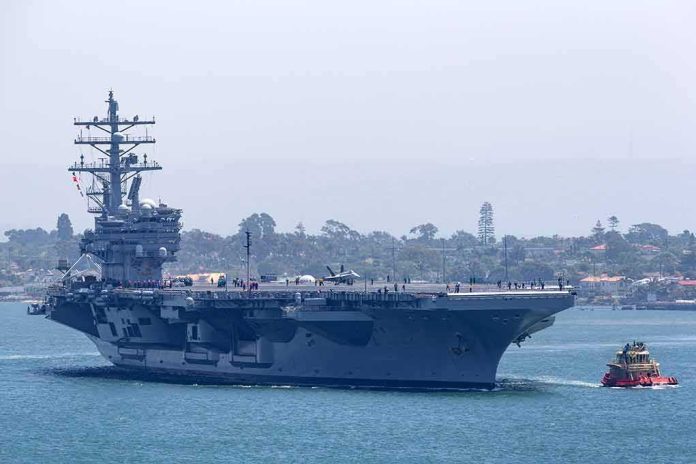
When sailors start contemplating the sea as an exit rather than a workplace, you are no longer debating messaging—you are confronting the operational limits of a fleet stretched past its human tolerances.
At a Glance
- Multiple sailors aboard USS Abraham Lincoln reportedly attempted to go overboard during an unusually long, high-tempo deployment; one overboard was confirmed and the sailor was recovered.
- Families describe severe morale erosion, exhaustion, and even suicidal ideation, alongside accounts of degraded habitability and supply shortfalls.
- Navy leaders acknowledge prolonged deployments strain crews, emphasize counseling and chaplaincy support, and say they have not detected a statistical spike in suicidal ideation or attempts.
- Congressional attention and the historical research literature align on a core truth: sustained maritime operations with little respite amplify mental-health risk and degrade readiness.
What we know, and what it signifies
Across credible reporting, two facts anchor the dispute. First, the deployment was extended well beyond normal expectations, with little liberty and high workload. Second, distress signals reached shore: families went public, one sailor fell overboard and was recovered, and reputable outlets reported additional attempts that the Navy has not precisely quantified. Military Times and NewsNation place these events squarely within the ship’s current cruise; the Navy confirms the single overboard recovery and denies deaths. The service’s official line is narrower—no identified increase in suicidal ideation or attempts based on its reporting channels—yet that statistical reassurance can coexist with real, acute distress at the deck-plate level.
The immediate significance is not whether a particular count clears a trend threshold. It is that sailors and families escalated concerns publicly during an ongoing deployment—an unwelcome but reliable signal in naval life that the strain-and-support balance has failed. When crews start losing faith that relief or repair is coming, command climate and cohesion suffer first; readiness follows.
How extended carrier deployments erode human performance
Carrier aviation is a fatigue engine when the cycle runs long. Flight deck ops compress sleep and magnify noise; watch bills compete with maintenance; underway replenishments fix calories and jet fuel but not always morale. The science is unambiguous: long hours, circadian disruption, perceived poor leadership support, and family stress correlate with higher rates of common mental disorder, anxiety/depression, and problem drinking in maritime forces. In a well-cited UK maritime study, 41.2% screened positive for probable common mental disorder; lower morale and cohesion tracked with worse outcomes, precisely the risk vectors families say intensified aboard Lincoln.
U.S.-focused research reaches similar conclusions. Studies of Navy deployment stress highlight inability to rest when needed, high job demands, and barriers to care as persistent pain points; these conditions reliably predict worse emotional health trajectories over time. The upshot is mundane but consequential: without periodic decompression—liberty, port calls, schedule stability—ships carry invisible debt. Crews can pay that debt for weeks; across months, interest outgrows coping capacity.
The facts in dispute, weighed honestly
Two narratives have formed. One, led by families and multiple outlets, asserts deteriorating conditions—food and water shortfalls, broken plumbing and ventilation, constrained basics—and ties those to collapsing morale and self-harm risk. KPBS and others platformed detailed family accounts. Al Jazeera cited a named spouse describing her sailor’s attempted jump amid severe burnout. Military Times reported multiple overboard attempts but acknowledged the Navy would not specify counts. These are specific, on-the-record claims, albeit mostly secondhand and not matched to published maintenance or medical logs.
The counter-narrative, articulated by Navy statements and amplified by Defense Secretary Pete Hegseth, is narrower: the reports are “completely misrepresented,” extended deployments do strain families, and the command sees no increase in reported suicidal ideation or attempts; support resources are in place. U.S. Central Command adds that no service members died and confirms the Aug. 3 overboard sailor was safely recovered. That is not a refutation of hardship; it is a defense against the charge of systemic neglect and a reminder that single events do not prove a statistical crisis.
Why the gap between deck-plate experience and official metrics persists
Two mechanisms routinely produce this kind of standoff. First, reporting pathways undercount distress in real time. Stigma, career fears, and the logistics of seeking help at sea depress formal tallies, while unit leaders may frame borderline cases as transient stress rather than reportable ideation. Research on operational stress control programs recognizes these chokepoints and emphasizes early, informal intervention; paradoxically, when those informal nets catch people, official incident counts can look stable even as raw distress rises.
Second, operational security and maintenance realities restrict disclosure. Commands rarely publish habitability faults or supply shortfalls mid-deployment; even benign details can telegraph vulnerability. Families therefore become the primary narrators, and media accounts aggregate their testimony. That evidentiary asymmetry does not make the accounts false; it makes them incomplete—and leaves the service leaning on generalized assurances. When Congress steps in, as ABC News reported, it is precisely to bridge that documentation gap with directed inquiries and deadlines.
Habitability, logistics, and the compounded risk of tempo
Carrier habitability is not a luxury item; it is a control variable in fatigue and error. Food monotony, rationing, or quality collapse erodes mood and energy. Water temperature issues drive hygiene workarounds that steal sleep. Broken ventilation invites mold, which inflames respiratory stress and saps resilience. In isolation, each is survivable; in combination, under a schedule of 12–14-hour days without liberty, they become risk multipliers. Comparative studies of maritime mental health consistently identify long working hours, poor sleep, poor perception of management, and low social support as additive hazards—conditions that align with the deployment profile families describe.
Overlay the strategic layer and the picture sharpens: surge requirements, limited port access, and contested logistics create unavoidable constraints. But “unavoidable” does not mean “costless.” Human-system integration demands command interventions that buy back margin—rotational relief, genuine rest cycles, visible transparency with families about timelines. When those lags lengthen, trust—the real ballast of any crew—leaks away.
What a responsible response looks like
The Navy’s immediate priorities are straightforward. First, stabilize the crew: lean forward on embedded behavioral health assets, chaplains, and peer-support leaders; increase voluntary check-ins and leader walk-arounds; proactively adjust watch bills and maintenance windows to recapture sleep. Second, clarify the relief plan within operational security bounds; uncertainty is itself a stressor. Third, remediate habitability defects that are fixable underway and surface those that are not for prioritized action post-relief. None of this concedes a statistical crisis; it concedes the human reality that prolonged strain, imperfectly measured, still demands action.
The medium-term fix is structural. Congress and Navy leadership must realign force-generation assumptions with fleet size and maintenance throughput, so that “surge” does not become the default posture. The research literature endorses decompression periods and predictable cycles as protective factors; each time the enterprise borrows against that predictability, it raises the interest rate paid in morale, retention, and safety incidents.
NEW: The USS Abraham Lincoln’s supply problems began after Iran heavily damaged the U.S. Navy base in Bahrain (NSA Bahrain) at the start of the war, knocking out a logistics hub the Navy had relied on for decades, NYT reports.
With other Gulf ports also vulnerable to Iranian… pic.twitter.com/SAZm0bgIdL
— Tabz (@TabzLIVE) August 15, 2026
How to read the next wave of documents
Expect FOIA releases and congressional letters to focus on three datasets. One, incident logs and medical transfers covering overboard events and self-harm. Two, habitability and logistics records—galley inventories, potable water tests, ventilation and plumbing work orders. Three, behavioral-health utilization and chaplain counseling trends. Together, they will not produce a single “gotcha” statistic; they will show whether the qualitative story families told matches the quantitative pattern an expert would expect in a long, liberty-starved cruise. If the numbers look flat, that will merit scrutiny of reporting pathways, not dismissal of lived experience.
Bottom line
The strongest evidence supports two conclusions. The deployment’s length and tempo pushed the USS Abraham Lincoln’s crew into a zone where distress becomes common and safety margins narrow. And the Navy’s official metrics, while important, are too blunt to adjudicate deck-plate suffering in real time. When families go public and a sailor is pulled from the water, the prudent institution acts first and tallies later. History, research, and common sense align on that principle; the fleet’s future retention and readiness depend on it.
Sources:
feedpress.me, militarytimes.com, theguardian.com, youtube.com, taskandpurpose.com, forbes.com, kpbs.org, abcnews.com, newsnationnow.com