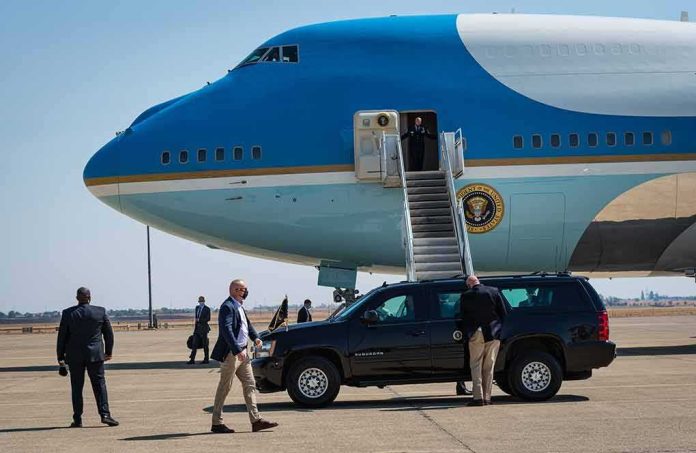
Presidential decoy operations are not new — the Secret Service has been swapping aircraft, routes, and even doubles for the commander in chief since the Cold War — but rarely has the tradecraft been so specific, so visual, and so instantly meme-able as a catering truck idling behind Air Force One on a tarmac in Ankara.
Key Points
- Multiple major outlets — the Washington Post, New York Times, Reuters, ABC News, BBC, and USA Today among them — reported that President Trump was covertly moved from Air Force One into an airport catering vehicle and onto a smaller military jet during his departure from the NATO summit in Turkey.
- The operation was reportedly triggered by a specific, credible Iranian assassination threat, with Trump himself publicly acknowledging he was “number one on their list.”
- Reporters and some staff aboard the decoy Air Force One were reportedly unaware the president was not on board, with window shades closed and tracking systems disabled.
- The White House has not issued a detailed on-the-record confirmation of the exact mechanics, and the core reporting rests on unnamed officials rather than released flight or security logs.
- The episode has become a flashpoint for partisan mockery and comparison, illustrating how security tradecraft gets reframed as political theater once it reaches social media.
What Happened in Ankara
The reporting is remarkably consistent across outlets with very different editorial slants, which is itself notable. Trump boarded Air Force One in Ankara on July 8 in full view of the traveling press pool. Minutes later, according to the Washington Post’s account as relayed by the New York Times, ABC News, and Reuters, he exited through a door on the far side of the aircraft, out of camera range, and was moved by an airport catering truck to a separate aircraft — a military C-32A, the smaller Boeing 757 variant typically used to ferry senior officials rather than the president himself. That jet, carrying Trump and reportedly Defense Secretary Pete Hegseth, flew separately while the original Air Force One departed on schedule with reporters and staff still aboard, several of whom did not know the president was not among them.
The New York Post reported that video “seems to document” the catering vehicle’s movement away from the aircraft, and BBC’s coverage independently described the same boarding-then-transfer sequence, noting that Trump declined to confirm whether he had switched planes when later asked. Both aircraft reportedly landed at RAF Mildenhall in England, where Trump transferred again — this time to the newer presidential jet — for the final leg home. The White House’s public explanation at the time, that Trump had taken the older aircraft so troops could tour the newer one, made no mention of a threat or a switch, a detail the subsequent reporting notably contradicts.
A Known Tool, Rarely Seen in Daylight
Decoy transport for heads of state is standard doctrine, not a novelty invented for this trip. The most frequently cited precedent, raised independently across several video breakdowns of this story, is President Clinton’s unannounced 2000 flight into Pakistan aboard an unmarked jet while Air Force One flew a separate, publicized route as a distraction — a maneuver undertaken specifically because of threat intelligence tied to that visit. The Secret Service and military airlift command maintain contingency protocols for exactly this scenario: multiple aircraft, altered call signs, disabled transponders, and misdirection of the press pool, all deployed when threat assessments cross a specific severity threshold. What makes the Ankara episode unusual is not the existence of the tactic but the mundane, almost absurd instrument used to execute it — a food-service vehicle — combined with the fact that it surfaced in detailed press reporting at all. Operational security around these movements typically depends on nobody outside a small circle ever describing them publicly.
What Is Confirmed, and Where the Reporting Still Leans on Trust
It is worth being precise about the evidentiary standing of this story, because the distinction matters even when the broad outline is not seriously contested. The reporting chain runs from the Washington Post’s original account, sourced to “a senior U.S. official” and “another person familiar with the president’s travel,” through New York Times corroboration, and then out to wire services and broadcasters who largely repeated rather than independently re-reported the core facts. ABC News, notably, stated plainly that it “has not confirmed the details of the story” even as it aired video coverage of it. No outlet in wide circulation has published a Secret Service movement log, an airport ramp-control record, or an unedited tarmac video that definitively places Trump inside the vehicle at a specific timestamp. That does not make the story false — the consistency across independently reported outlets citing separate official sources is itself meaningful corroboration, and the White House’s own response, which spoke of “many enemies” and “every tool at our disposal,” effectively conceded the security context rather than denying it. But the granular mechanics — exactly where Trump sat, how long the transfer took, who else knew in real time — remain dependent on sourcing the public cannot independently audit.
From Security Briefing to Punchline
Once a story like this clears the anonymous-sourcing stage, it enters a second life entirely governed by political incentive rather than evidentiary caution. Commentary across social platforms split almost immediately into two competing frames: one treating the episode as sober confirmation that a foreign state posed a live threat to a sitting president, and the other seizing on the image of a catering cart to recast a documented security protocol as an act of cowardice or farce. Clips from CNN, Fox affiliates, and independent commentary channels racked up hundreds of thousands of combined views within days, most of them built around the visual absurdity rather than the underlying threat assessment. This is the pattern worth naming precisely because it recurs with every administration: the operational substance of a protective measure gets flattened into a single humiliating image, and that image — not the intelligence briefing behind it — becomes what most of the public actually retains. Comparisons to how past presidents handled comparable threats say less about the men involved than about which administration’s security lapses happened to generate footage.
IPINUSLIT GAMIT CATERING CART?
It had the makings of a #spy thriller: an alleged #Iranian threat, a shoulder-fired missile, a decoy Air Force One and a president slipping away from the cameras.
According to The New York Times, U.S. intelligence detected a specific… pic.twitter.com/64ucwGNyeg
— Daily Tribune (@tribunephl) August 12, 2026
Why the Distinction Between Threat Response and Theater Matters
The durable lesson here has little to do with any single president and everything to do with how institutions handle credible threats under public scrutiny. Protective services have strong, legitimate reasons never to fully disclose the mechanics of how they move a principal under threat — full transparency would hand adversaries a blueprint for the next attempt. That operational necessity, though, collides directly with a press corps and public that expect candor about presidential movements, especially when journalists themselves were unknowingly used as part of the deception. The tension is structural and will recur under any administration facing a genuine threat: security demands secrecy, democratic accountability demands disclosure, and the gap between them is where stories like this one get contested, mocked, and eventually half-forgotten before the underlying threat assessment is ever made public.
Sources:
twitchy.com, nypost.com, independent.co.uk, yahoo.com, facebook.com, aol.com, newscord.org