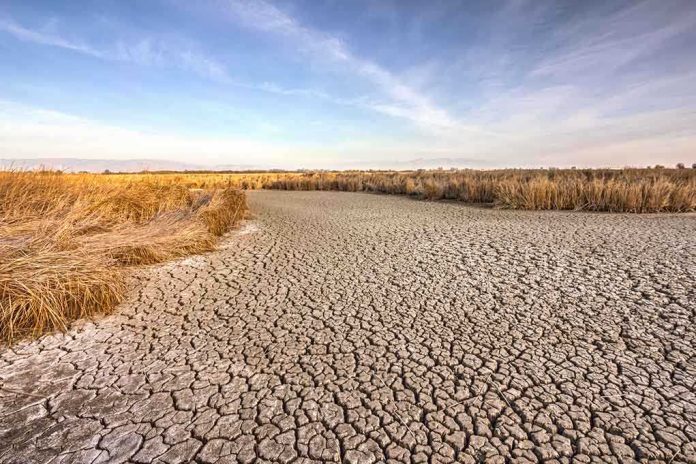
Extreme heat does more than punish landscapes and strain infrastructure; it briefly turns the ground into a diagnostic instrument, exposing buried archaeology and submerged history that ordinary weather keeps hidden. That is why record heatwaves keep producing the same uncanny effect across Europe: old field systems, forgotten settlements, military remains, and even deep-time fossils suddenly become legible.
Key Points
- Dry soil and falling water levels reveal hidden remains by changing vegetation, sediment, and visibility from the air.
- The most convincing finds come from repeatable mechanisms such as crop marks, parch marks, and river drawdown, not from novelty framing.
- Britain, Wales, Ireland, and parts of continental Europe have all produced the same pattern of exposure during hot, dry spells.
- The story is not that heat creates history; it is that heat exposes history already there, often with surprising speed and clarity.
How Heatwave Archaeology Actually Works
The mechanism is straightforward, and archaeologists know it well. When rain is scarce, buried walls, ditches, pits, and foundations alter how moisture is retained in the soil above them; crops rooted over a filled-in ditch may stay greener longer, while those growing over stone or compacted deposits wither sooner. The result is a readable pattern on the surface, known as crop marks or, in grassland, parch marks. Aerial survey teams have used those patterns for decades, and the recent run of dry summers simply made the process unusually productive.
This is why the best reports do not present heatwave finds as mysterious “discoveries” in the romantic sense. They are detections. In England and Wales, aerial archaeologists have identified Neolithic ceremonial monuments, Iron Age settlements, Roman farms, burial mounds, and First World War practice trenches because the drought sharpened contrasts in vegetation and soil moisture. The same principle applies when rivers recede: low water strips away concealment and exposes wrecks, military hardware, industrial debris, and older organic remains that had sat protected in mud or sediment for decades.
Why Britain and Wales Recur in These Stories
Britain and Wales appear so often in this subject because the combination of landscape, land use, and survey tradition is unusually favorable. Large tracts of farmland and pasture sit atop long-continuously occupied terrain; when a dry spell arrives, the differences between buried features and surrounding soil become visible across broad fields at once. That is why Historic England-linked coverage repeatedly turns up prehistoric monuments, Roman sites, medieval field systems, and later military traces in the same weather window.
The Wales coverage is especially useful because it shows the breadth of what dry weather reveals. BBC reporting described hidden remains including Roman buildings and practice trenches from the First World War, while other coverage of the same type of event pointed to prehistoric long barrows, forts, and newly visible settlement patterns. The point is not that every visible line in a field is equally important; it is that drought acts as a revealing condition across many periods at once. That gives archaeologists a rare, landscape-scale look at continuity, reuse, and erasure.
From Forgotten Gardens to War Relics and Fossil Bone
The European dimension broadens the story beyond crop marks. In Budapest, low Danube levels exposed a Wehrmacht motorcycle, soldiers’ remains, and World War II ammunition on the riverbed; in Serbia, receding water has also exposed a cluster of wartime vessels and other riverborne relics. These are not archaeological finds in the narrowest academic sense alone; they are evidence that waterlogged concealment can preserve modern material just as effectively as it preserves prehistoric wood or bone.
Other finds sit at the opposite end of the temporal spectrum. Reports from Bulgaria described mammoth bones, including a lower jaw and tusks, emerging near Ryahovo as the Danube fell, an illustration of how deep-time remains can surface when sedimentary cover is disturbed or stripped away. And on drier land, parched ground has exposed the outlines of a long-lost seventeenth-century formal garden at Chatsworth House, a reminder that “hidden history” is not only ancient or martial; it can also mean the physical traces of landscape design, taste, and labor that vanished from view centuries ago.
What the Skepticism Gets Wrong, and What It Gets Right
There is little serious counter-evidence to the core mechanism. No credible source in the research package disputes that drought and heat can reveal buried remains through crop marks or that falling water can expose riverbed and reservoir finds. The more meaningful caution is narrower: headline circulation can blur the line between genuinely new discoveries, re-exposed known sites, and finds whose identification is still provisional. That is a problem of interpretation and provenance, not a refutation of the phenomenon itself.
That distinction matters. A field mark seen from the air may indicate a known site reappearing under unusually dry conditions, or it may reveal something previously unrecorded; a bone lifted from a riverbank may be a spectacular find, but the identification still depends on museum expertise and recovery records. The public narrative often compresses these steps into a single dramatic sentence. Specialists do not. They separate visibility, recovery, classification, and dating because each stage carries its own margin of error.
Why These Finds Matter Beyond the Headline
The real significance of heatwave archaeology is methodological. Extreme weather does not merely add dramatic images to the news cycle; it creates a temporary observational advantage, allowing archaeologists to map landscapes that are otherwise opaque. That has practical value for heritage protection, since newly visible sites can be documented before ploughing, erosion, construction, or looting damage them. It also has interpretive value, because the distribution of marks across a landscape can show how communities organized fields, defended territory, buried their dead, or repurposed ground over centuries.
Just as important, these episodes quietly remind us that the past is not buried all at once and then gone; it persists in layers, conditions, and survivals, waiting for the right pressure to make it legible again. Heatwaves simply supply that pressure. They strip away the visual noise. Then the record appears.
Sources:
mirror.co.uk, theguardian.com, bbc.com, youtube.com, lavanguardia.com, news.artnet.com, moneycontrol.com, bbc.co.uk, omidradio.com, livescience.com, sciencealert.com, smithsonianmag.com, pbs.org, newyorker.com