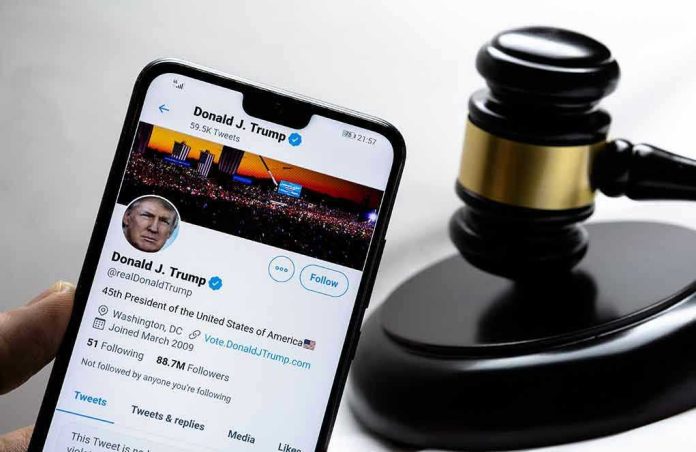
President Trump’s exercise of clemency powers in the case of Roger Stone underscores the continued struggle between political loyalty and the rule of law.
Story Snapshot
- Trump commuted Roger Stone’s three-year prison sentence, raising questions of political favoritism.
- Stone’s convictions were connected to the Mueller investigation into the 2016 election.
- The commutation sparked criticism from both Democrats and some Republicans.
- This event highlighted concerns over the politicization of the justice system.
Trump’s Controversial Clemency Decision
On July 10, 2020, President Donald Trump commuted the prison sentence of Roger Stone, a longtime adviser and political ally. Stone had been convicted on multiple felony charges, including lying to Congress and witness tampering, all stemming from the Mueller investigation into Russian interference in the 2016 election.
The decision to commute Stone’s sentence was widely seen as an act of political loyalty, given Stone’s close relationship with Trump and the president’s repeated criticism of the Mueller probe as a “witch-hunt.”
Critics, including former Special Counsel Robert Mueller, argued that the commutation undermined the rule of law. Mueller publicly broke his silence to emphasize that Stone’s convictions were based on real federal crimes, reinforcing the integrity of the legal process that led to Stone’s sentencing.
This move by the president, while within his constitutional powers, was perceived as setting a dangerous precedent by using clemency to shield a political ally rather than correcting a miscarriage of justice.
Reactions and Political Implications
The commutation drew sharp criticism from various political figures. Speaker Nancy Pelosi labeled the decision “appalling,” while Republican Governor Larry Hogan warned of potential political fallout.
Attorney General William Barr, who oversaw the prosecution, acknowledged the righteousness of the case but also recognized the president’s authority to grant clemency. The incident heightened partisan divisions, questioning the impartiality of the justice system and energizing Democratic opposition to Trump’s presidency.
While Stone avoided prison, he remained a convicted felon, a status that underscored the seriousness of his offenses. The decision further fueled debates over the appropriate use of presidential clemency, particularly in high-profile cases involving political figures. It contributed to growing concerns about the politicization of justice and the equal application of the law, with critics arguing that such actions could erode public trust in legal institutions.
Long-term Consequences and Historical Context
Trump’s use of clemency in Stone’s case is part of a broader narrative of his presidency, where the boundaries of traditional political norms were tested. Historically, presidential clemency has been a tool for correcting injustices or showing mercy based on rehabilitation. However, Trump’s frequent use of this power for political allies marked a departure from these norms, raising questions about the erosion of accountability for those in power.
The commutation set a precedent that could influence future administrations, potentially affecting how justice is perceived and administered in politically sensitive cases. It emphasized the need for ongoing vigilance in safeguarding the integrity of the justice system against political interference, ensuring that the rule of law applies equally to all, regardless of political connections.
Sources:
Roger Stone: Trump spares ex-adviser from prison, sparking critics’ anger